Why don't firms publish pay in their job adverts?
We present the first experimental evidence on how (not) posting wages changes the applicant pool, and whether that gives firms a reason to hide wage info.
Great short thread by my co-author Lukas + link to the full paper👇
10.10.2025 17:12
👍 20
🔁 3
💬 1
📌 1

What the Tough Job Market for New College Grads Says About the Economy
A sudden lack of career mobility is a problem for every worker.
I didn’t find any of the explanations for what’s going on with the bad job market for new college grads satisfying, so I spent a week trying to figure out what was up and what it means for the larger economy. Turns out it’s not AI! Gift link: www.bloomberg.com/news/article...
17.07.2025 13:31
👍 749
🔁 190
💬 26
📌 27


We're hiring a postdoc in labor economics at IAB Nuremberg! Join @ineshelmecon.bsky.social, @jnimczik.bsky.social & me on a project about gig work.
🗓️ Start: 1 Oct 25
💶 Salary ≥ €5200/month
🌱 Possibility to apply for tenure track program
Apply here until 17 June: econjobmarket.org/positions/11...
02.06.2025 10:22
👍 31
🔁 27
💬 0
📌 3
I haven't fully absorbed this whole situation, but I think it brings forward somethings we know about economics: a) very strong prestige basis, b) our obsession with new automation for data wrangling and production, c) basis for novelty, d) some people's lack of respect for empirical work
17.05.2025 13:19
👍 36
🔁 6
💬 3
📌 2

Devastating news that @iza.org is effectively closing down 😔
It was (or at the moment, is) a wonderful institute and the network was tremendously helpful in dissaminating work in labour economics.
IZA will sorely be missed 😢
So sorry for all IZA employees!
24.02.2025 15:36
👍 119
🔁 29
💬 7
📌 11
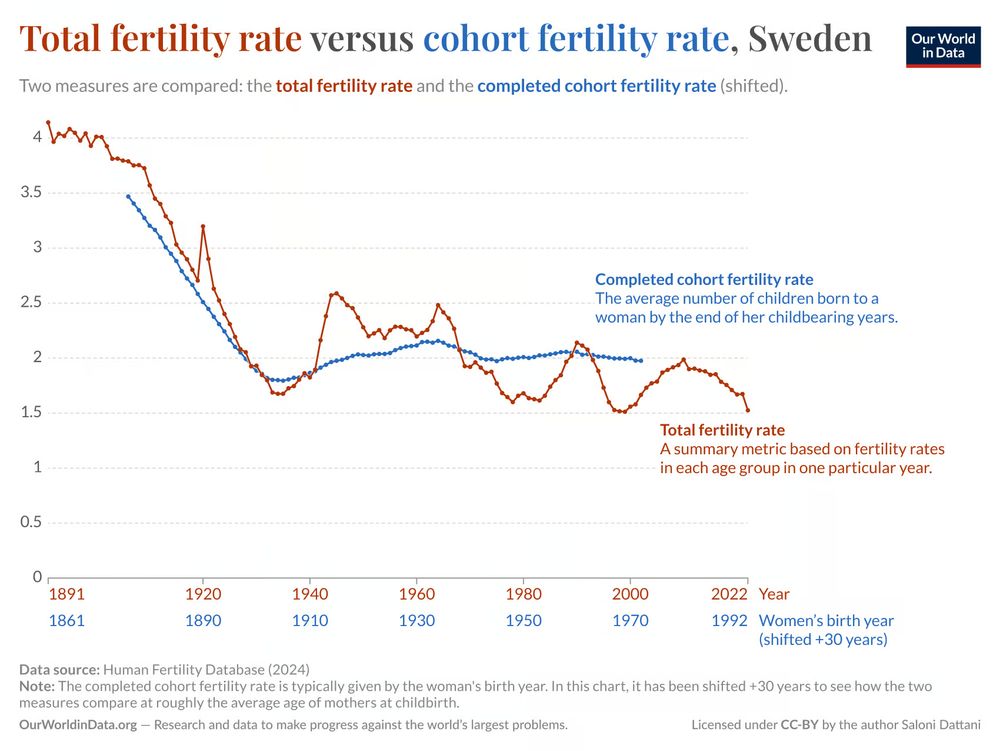
A line graph compares two measures of fertility rates in Sweden over time: the total fertility rate and the completed cohort fertility rate.
The total fertility rate is depicted using a red line, which shows a downward trend starting around the early 1900s, with fluctuations and a gradual decline to about 1.5 in 2022.
The completed cohort fertility rate is illustrated with a blue line, with the time axis showing the women's birth year. It shows an initial decline followed by a stable fertility rate.
A note at the bottom states that the completed cohort fertility rate has been shifted by 30 years to align with the respective birth years of women. The data source is the Human Fertility Database (2024) and the chart is published by Our World in Data.
New article by me!
It's a common mistake to think the TFR is a prediction of the average number of children women will have over their lifetimes.
But it's not. The TFR can decline even when the eventual number of children per woman stays constant or even increases; the opposite can happen too. 🧵
24.02.2025 08:12
👍 227
🔁 61
💬 11
📌 9
#econjmp How do less affluent students respond to student finance induced increases in cost?
🎓Move to full loan policy: ⬇️ enrolment rates of eligible pupils
⚙️Effect driven by ⬆️ costs but also heightened concerns with debt 💰
⚠️Overall: ⬇️teacher supply + narrowed access to university
#econjobmarket
20.11.2024 12:08
👍 15
🔁 9
💬 0
📌 0
A few months ago, I've joined @bankofengland.bsky.social as a Researcher, and I couldn't be happier.
If you're on the market - or just curious about working as a researcher in a central bank - join the Q&A session about the PhD Research Programme on October 23: www.eventsforce.net/bankofenglan...
21.10.2024 16:14
👍 5
🔁 0
💬 0
📌 0
Very excited this great JMP by my colleague
@czimpelmann.bsky.social is finally out!
We've always *known* gender norms matter for female labour supply, but now we have actual *evidence* at the individual level!
Come for the new stylised facts, stay for deep policy implications 👇
21.11.2023 13:13
👍 2
🔁 0
💬 0
📌 0
That's what I'd expect too - would love to see the evidence as well!
Also, many interesting related questions: is the quality of match & wages lower/higher with no relocation necessary? How much do firms take advantage of recruiting from anywhere?
17.11.2023 13:18
👍 0
🔁 0
💬 0
📌 0
I haven't written down a model, but I'd say if wage = marg. prod, we wouldn't expect this pattern
However, in the presence of search frictions, I wouldn't expect workers to be paid their marginal product anyway...
2/2
16.11.2023 15:46
👍 1
🔁 0
💬 0
📌 0
Great question! Could be several things:
- within occup, higher wages reflect better matches (wage = worker qual + firm qual + match qual)
- cost of firing (as you say)
- cost of worker relocation only pays back for high wage jobs
1/2
16.11.2023 15:46
👍 1
🔁 0
💬 1
📌 0
thank you Emma!
16.11.2023 15:30
👍 1
🔁 0
💬 0
📌 0
Finally, massive thanks to Kory Kroft, Davin Pope, Milena Djourelova, Ruben Durante and Gregory J. Martin for generously sharing their data on Craigslist expansion and posts!
16.11.2023 09:56
👍 0
🔁 0
💬 0
📌 0
... but at the same time, ~1/3 of jobs aren't online at all, with lower-wage, lower-educ occupations particularly underrepresented - making this question still relevant today.
If you want to learn more, including what Kijiji is, full paper available here: mariabalgova.github.io/JMP.pdf
16.11.2023 09:54
👍 1
🔁 0
💬 1
📌 0
TL;DR: I show online job boards made it easier for workers to find better opportunities across space, increasing wages and mobility as a result.
Ofc, hiring online today looks very different, with AI helping to pick best candidates and guide job search...
16.11.2023 09:54
👍 1
🔁 0
💬 1
📌 0

(iii) within cities, increase in migration inflows and increase in wages should be concentrated in the same occupations
I find that this is true for Craigslist cities but not for control cities, where the relationship is negative - driven by labour supply rather than by better matching.
16.11.2023 09:53
👍 0
🔁 0
💬 1
📌 0


Given these patterns in baseline recruitment, we'd expect
(i) Craigslist to have larger impact in occupations with high non-local recruitment in 1990
(ii) the impact to be larger for higher wages where the quality of match often matters most
This is exactly what I find!
16.11.2023 09:53
👍 1
🔁 0
💬 2
📌 0


The data shows that firms recruit non-locally to find specific talent rather than to hire cheaply:
- non-local vacancies are posted in large markets with higher wages & lower-unemployment
- firms target markets which specialise in the occupation they’re searching for
16.11.2023 09:52
👍 1
🔁 0
💬 1
📌 0
I address this 2nd challenge by exploiting the placement of help-wanted ads across US newspapers in 1990.
Because firms had to make conscious choice about which newspaper to advertise in, this data uniquely captures which jobs were posted non-locally and why.
16.11.2023 09:51
👍 1
🔁 0
💬 2
📌 0
Higher migration + higher wages suggest that Craigslist improved matching between cities.
However, without any data on firm recruitment, it's hard to identify what drives these results.
For all we know, the migration and wage effects might be caused by different mechanisms!
16.11.2023 09:51
👍 1
🔁 0
💬 1
📌 0

At the same time, average wages in the treated cities went up by about 0.8% annually, putting an end to convergence in pay.
16.11.2023 09:51
👍 1
🔁 0
💬 1
📌 0
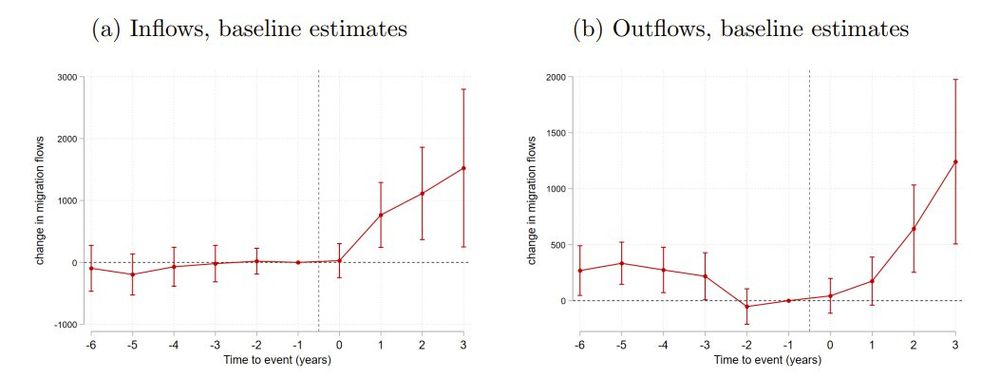

I find that Craigslist entry into a city significantly increased geographic mobility in and out of the city.
Looking at changes in bilateral city-to-city migration flows, almost all of the increase in migration churn is driven by greater mobility between Craigslist cities.
16.11.2023 09:50
👍 1
🔁 0
💬 1
📌 0
First challenge: the internet radically changed many aspects of life at the same time, making it difficult to identify the effect of online recruitment alone.
My solution: focus on the staggered rollout of one of the first online job boards, Craigslist, across US cities.
16.11.2023 09:49
👍 0
🔁 0
💬 1
📌 0
We know the introduction of the internet improved efficiency in matching *within* local labour markets.
However, internet also kills distance --> should make it easier for firms and workers to match *between* markets.
My paper is the first to explore this channel empirically.
16.11.2023 09:49
👍 0
🔁 0
💬 1
📌 0

Excited to share my new WP (which also happens to be my job market paper!)
How does online recruitment impact the geography of the labour market?
Full paper here sites.google.com/view/mariaba...
and a thread below:
16.11.2023 09:48
👍 31
🔁 11
💬 2
📌 1
this is still pre-growth in work from home, but it does show a high degree of persistence in non-local recruitment patterns over time
16.11.2023 09:40
👍 0
🔁 0
💬 0
📌 0

That's the next question!
However, I can share one graph (that didn't make it into the paper) that gets us a bit closer to answering this: the share of non-local recruitm. in 1990 is highly predictive of recruitm. online in 2015, with convexity at the top end - more polarisation across occupations
16.11.2023 09:39
👍 2
🔁 0
💬 1
📌 0
Thank you @maxnathan.bsky.social for this great thread about my job market paper!
16.11.2023 09:31
👍 2
🔁 0
💬 1
📌 0
Not what I hoped my first post to be, but:
@simonjaeger.bsky.social has been an excellent boss, colleague and mentor, and it's devastating that his vision for IZA will not get a chance to materialise. He achieved a lot in his short time at IZA, and I'm really grateful I got to be a part of it.
10.11.2023 16:59
👍 6
🔁 0
💬 0
📌 0