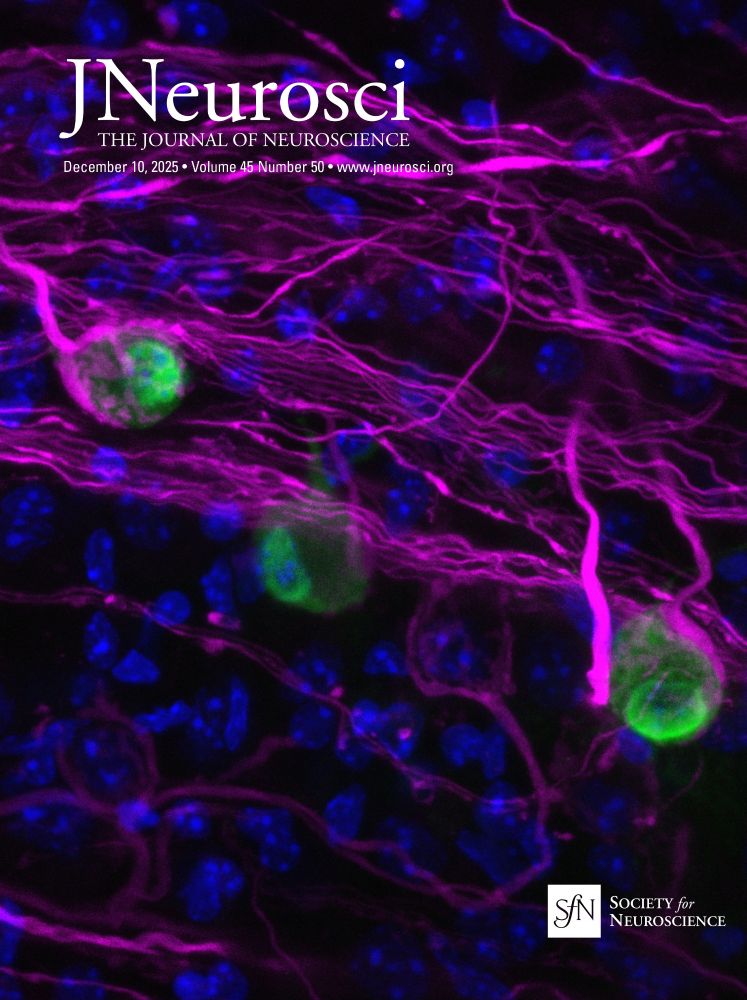
New review paper!
We extensively inquire inhibitory interneurons in NHP PFC, compared it to rodent literature, by integrating decades of research on their cellular diversity, circuit roles, and functions in attention, memory mainentance and adaptive behavior.
authors.elsevier.com/a/1mOl314SFm...
11.02.2026 23:31
👍 1
🔁 0
💬 0
📌 0
Thanks to co-authors @randolph-helfrich.bsky.social l
@fiebelkornian.bsky.social rnian.bsky.social
Peter Brunner
Nicole Bentley
Jack Lin
Bob knight
03.12.2025 22:02
👍 0
🔁 0
💬 0
📌 0
- Using spiking neural network models, we show that HFAbs reflect state transitions in population activity, and a four-network model demonstrates attention-mediated fast HFAb communications enhances probability of target detection.
03.12.2025 22:02
👍 0
🔁 0
💬 1
📌 0
- HFAbs in cue subnetworks predict behavioral accuracy following cue onset, and precede target subnetworks following target onset when cues are informative for target detection.
03.12.2025 22:02
👍 0
🔁 0
💬 1
📌 0
- HFAbs are synchronized brain-wide.
- HFAbs are strongly coupled to slower brain rhythms but transiently decouple during active processing, such as cue and target periods.
- Network-level synchronization patterns of HFAbs reveal functional subnetworks for cue and target processing.
03.12.2025 22:02
👍 0
🔁 0
💬 1
📌 0
We demonstrate that transient bursts of high-frequency activity (HFAbs) in the human brain facilitate attentional performance and support fast, large-scale information routing.
Using intracranial EEG recordings and spiking neural network modeling we show:
03.12.2025 22:02
👍 0
🔁 0
💬 1
📌 0
Thanks to co-authors @randolph-helfrich.bsky.social
Ian Fiebelkorn
Peter Brunner
Nicole Bentley
Jack Lin
Bob knight
03.12.2025 14:03
👍 0
🔁 0
💬 0
📌 0
- Using spiking neural network models, we show that HFAbs reflect state transitions in population activity, and a four-network model demonstrates attention-mediated fast HFAb communications enhances probability of target detection.
03.12.2025 14:03
👍 0
🔁 0
💬 1
📌 0
- HFAbs in cue subnetworks predict behavioral accuracy following cue onset, and precede target subnetworks following target onset when cues are informative for target detection.
03.12.2025 14:03
👍 0
🔁 0
💬 1
📌 0
- HFAbs are strongly coupled to slower brain rhythms but transiently decouple during active processing, such as cue and target periods.
- Network-level synchronization patterns of HFAbs reveal functional subnetworks for cue and target processing.
03.12.2025 14:03
👍 0
🔁 0
💬 1
📌 0
We demonstrate that transient bursts of high-frequency activity (HFAbs) in the human brain facilitate attentional performance and support fast, large-scale information routing.
We show:
- HFAbs are synchronized brain-wide.
03.12.2025 14:03
👍 0
🔁 0
💬 1
📌 0
Thanks Marcus!
03.12.2025 13:02
👍 1
🔁 0
💬 0
📌 0
Redirecting
Really delighted to share our new article in Current Biology showing that the cingulate-to-dorsolateral prefrontal pathway is not involved in trial-to-trial short-term adaptation but rather in sustained motivational control.
doi.org/10.1016/j.cu...
02.11.2025 12:52
👍 36
🔁 11
💬 0
📌 0
A sad day for Neuroscience in the Netherlands.
30.10.2025 23:56
👍 15
🔁 5
💬 0
📌 0
Our newest preprint! Work led by Ben Dykstra (co-mentored by @gordonberman.bsky.social). Some of the first recordings from the iCA3 region during social behaviors. Ben found that iCA3 neurons more strongly represent social recognition information relative to iCA1 . www.biorxiv.org/cgi/content/...
28.10.2025 02:15
👍 12
🔁 6
💬 2
📌 1

Flexible perceptual encoding by discrete gamma events - Nature
Using a new analytical method for tracking gamma band events in mouse visual cortex, flexible encoding of visual information according to behavioural context is shown.
(1/8) My latest study is out in @nature.com ! Kudos to coauthors especially @jess-cardin.bsky.social and to @kavliatyale.bsky.social and @wutsaiyale.bsky.social for support. We find that gamma power in mouse visual cortex is caused by brief events of visual processing www.nature.com/articles/s41...
08.10.2025 17:04
👍 33
🔁 6
💬 2
📌 1

Transcriptomic diversity of amygdalar subdivisions across humans and nonhuman primates
Specialized cell types and links to psychiatric disorders are revealed by genetic mapping of primate amygdala neurons.
A spatially resolved transcriptomic atlas of the primate amygdala (human, macaque, and baboon) now out in Science Advances (www.science.org/doi/10.1126/...). The amygdala contains 32 types of neurons with many neuron types specific to particular subdivisions.
Lots of updates from the preprint!
17.09.2025 19:31
👍 118
🔁 46
💬 9
📌 3
Hearing this argument always reminds me of earthquakes! You can decode them miles away from the site, but detectability doesn’t make the epicenter anything other than the epicenter.
07.09.2025 02:58
👍 3
🔁 1
💬 0
📌 0
Congrats!
29.08.2025 01:18
👍 2
🔁 0
💬 0
📌 0
The latter only tracks neurons that were present in the first session and labels them consistent with their original labels in the first session.
01.08.2025 12:57
👍 0
🔁 0
💬 0
📌 0
Thanks, yes, for long recording sessions and data across multiple sessions, chronic recordings were tested. For multiple sessions there are two options: either concatenate data across sessions and then perform the sorting, or train the it on one session and perform the sorting on another session👇
01.08.2025 12:57
👍 0
🔁 0
💬 1
📌 0
Check out the website for a detailed guide and overview:
kiasort.com
01.08.2025 00:33
👍 6
🔁 1
💬 1
📌 0