

A photo of UNC Chapel Hill's campus.
UNC Chancellor Scraps Secret Recording Policy https://bit.ly/4aMlew6
03.03.2026 00:04
👍 5
🔁 2
💬 0
📌 1
A photo of UNC Chapel Hill's campus.
UNC Chancellor Scraps Secret Recording Policy https://bit.ly/4aMlew6
EPA claims repeal will be "de minimis." Based on our forthcoming work on wildfire smoke (below) and a back-of-the-envelope calculation from Table 1 in the final rule, I estimate this action will kill over *200,000 Americans* over the 21st century. De minimis indeed!
www.nber.org/papers/w33829

While others are stepping back on climate, Project Drawdown is stepping up!
We’re proud to announce the Climate Science Serving America Fellowship to support U.S.-based Ph.D.-level scientists & engineers focused on climate solutions for the public good.
drawdown.org/news/project...

Want to know how many disaster declarations are being made under the 2nd Trump Administration, and how long they are taking? I made a simple dashboard to help: andrewrumbach.substack.com/p/a-dashboar...

It must be very hard to publish null results Publication practices in the social sciences act as a filter that favors statistically significant results over null findings. While the problem of selection on significance (SoS) is well-known in theory, it has been difficult to measure its scope empirically, and it has been challenging to determine how selection varies across contexts. In this article, we use large language models to extract granular and validated data on about 100,000 articles published in over 150 political science journals from 2010 to 2024. We show that fewer than 2% of articles that rely on statistical methods report null-only findings in their abstracts, while over 90% of papers highlight significant results. To put these findings in perspective, we develop and calibrate a simple model of publication bias. Across a range of plausible assumptions, we find that statistically significant results are estimated to be one to two orders of magnitude more likely to enter the published record than null results. Leveraging metadata extracted from individual articles, we show that the pattern of strong SoS holds across subfields, journals, methods, and time periods. However, a few factors such as pre-registration and randomized experiments correlate with greater acceptance of null results. We conclude by discussing implications for the field and the potential of our new dataset for investigating other questions about political science.
I have a new paper. We look at ~all stats articles in political science post-2010 & show that 94% have abstracts that claim to reject a null. Only 2% present only null results. This is hard to explain unless the research process has a filter that only lets rejections through.
SUPER excited to see this live in the world. In particular hugely admire this team's dedication to openness and transparency about methodology, code, assumptions.
Every tool has strengths and weaknesses, but sharing openly is how the whole community can improve. Big kudos @carbonplan.org

"Our main conclusion ... is that several well-cited messaging strategies reliably influence pro-environmental attitudes and behavioural intentions in the United States ... We found little evidence of heterogeneous treatment effects between Democrats and Republicans..."
"The study’s findings are also in line with previous research: A 2021 study suggested that PM2.5 from wildfires is up to 10 times more harmful than PM2.5 from other sources, such as ambient pollution."

New data show that business concentration has increased persistently in many countries over the past century by sales, net income, and capital, but not by employment, from Yueran Ma, Mengdi Zhang, and Kaspar Zimmermann www.nber.org/papers/w34711

NSF just posted their Dear Colleague Letter regarding the restructuring of NCAR. www.nsf.gov/funding/info...
@nws.noaa.gov's experimental probabilistic precip forecast shows the chance of snow, ice, and total accumulations through Monday
any primers on this in utilities you can recommend?

Map of water table depth across the continental United States at 30-meter resolution, with inset panels showing detail at 100km, 10km, and 1km scales in both eastern and western US locations. Color scale shows depth from shallow (blue) to deep (yellow) on a log scale.
New work from our team: we mapped water table depth at 30-meter resolution across the entire continental US.
That's ~8 billion grid cells, trained on over 1 million well observations. Highest-resolution estimate to date.

rabbit hole OTD "I consider the role of animals in gentrification processes ... how the materialities of horse bodies are embodied in specific landscape changes: qualities of pasture, styles of fencing and stables ... and lead to the territorialisation and contestation of broader rural landscapes."

Neptune Flood (subsidiary of NYSE:NP) is actively working to privatize the NFIP. Company leadership has communicated their work and this goal, in line with Project 2025, to the White House.
Privatization would have big implications for flood-prone communities.
www.nytimes.com/2026/01/15/c...
Caveat here being that 5cm hail is listed as being where damage to buildings starts... but based on an EU study where much more of the building stock is tile roof.
Asphalt shingles, obviously much more common in US, take damage and need replacement at much smaller hail sizes.

Have you ever heard of the black-white mortality crossover?
Before about 82, black men have higher age-specific probabilities of dying than white men.
Between roughly 82–86, the gap closes.
After 86, the pattern actually reverses: white men become more likely to die at each age than black men.

A map of the US with each 2025 billion-plus dollar weather and climate disaster geo-located on it. Source: Climate Central
After the US admin cancelled the $B Climate + Weather Disaster dataset, @climatecentral.org hired the scientists who ran it and set it back up.
Now the 2025 numbers are in: it's 3rd highest year on record and highest year w/o land-falling hurricanes.
More: www.climatecentral.org/climate-serv...

County officials told KQED on Monday the exact damage estimates aren’t yet known, but that hundreds of structures were impacted by the flooding brought on by stronger-than-expected rainfall and king tides, the highest tides of the year. (via @kqednews.kqed.org)

"Nutrition is a central determinant of human health, yet the direct impacts of climate on dietary intake remain poorly understood ... [we] show that both extreme heat and cold trigger a shift toward energy-dense diets, adding a previously overlooked behavioral channel to the climate–health nexus."


Researchers recently asked Americans what income level other people need in order to live a good life.
A whopping 86% of Americans reported income levels well below what others say they themselves need.
Fascinating!

'respondents with multiple flood experience are more likely to perceive social norms supporting individual protective behavior, ascribe more responsibility to public authorities and less to their community'
nhess.copernicus.org/articles/25/...


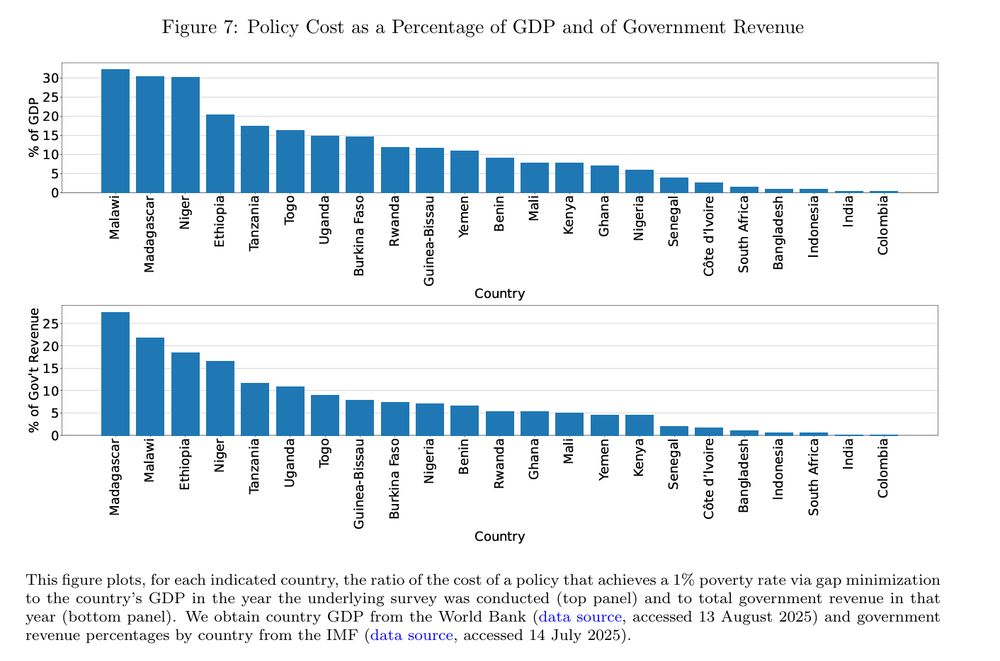
What would it cost to end extreme poverty?
"We estimate that reducing the poverty rate to 1% ... would cost $170B nominal per year."
"The results correspond to a cost of (approximately) ending extreme poverty of roughly 0.3% of global GDP."
Where rivers have flooded in 2025, using data from USGS and @nws.noaa.gov
#StateOfFlood

@ucs.org has released a letter you can write to your Congressperson to save @ncar-ucar.bsky.social
Share your voice on the significant value of this bedrock climate and weather insitution. Your story matters!
secure.ucs.org/a/2025-prote...
"under-the-radar trends showcased how countries with aging populations and shrinking birthrates are seeking to fill labor market and skills gaps"
You know those dropsondes that get dropped into hurricanes and improve the forecasts by up to 20%?
Those are developed by NCAR and manufactured in Colorado by Vaisala.
Without NCAR developing the dropsonde, the algorithms, and software that operate it, hurricane forecasting takes a huge step back.
Time to repurpose #AGU25 as a mass mobilization in support of NCAR, NSF, NOAA, NASA, USGS, DOE BER, and the Congressional power of the purse.

