Constraints on chromosome evolution revealed by the 229 chromosome pairs of the Atlas blue butterfly
The genome of the Atlas blue butterfly contains ten times more chromosomes than most
butterflies, and more than any other known diploid animal. Wright et al. show that
this extraordinary karyotype is ...
How many chromosomes can an animal have?
In our paper out now in @currentbiology.bsky.social we show that the Atlas blue butterfly has 229 chromosome pairs- the highest in diploid Metazoa! These arose by rapid autosome fragmentation while sex chromosomes stayed intact.
www.cell.com/current-biol...
11.09.2025 15:21
👍 215
🔁 99
💬 4
📌 6
Best guess would be Tragopogon sp., the salsifies, also known as goatsbeard! They have a neat polymorphism where seeds near the interior of the flowering head are smaller and better-suited for long-distance wind dispersal, while outer seeds and those that face downward are larger / less mobile
04.05.2025 16:18
👍 1
🔁 0
💬 0
📌 0


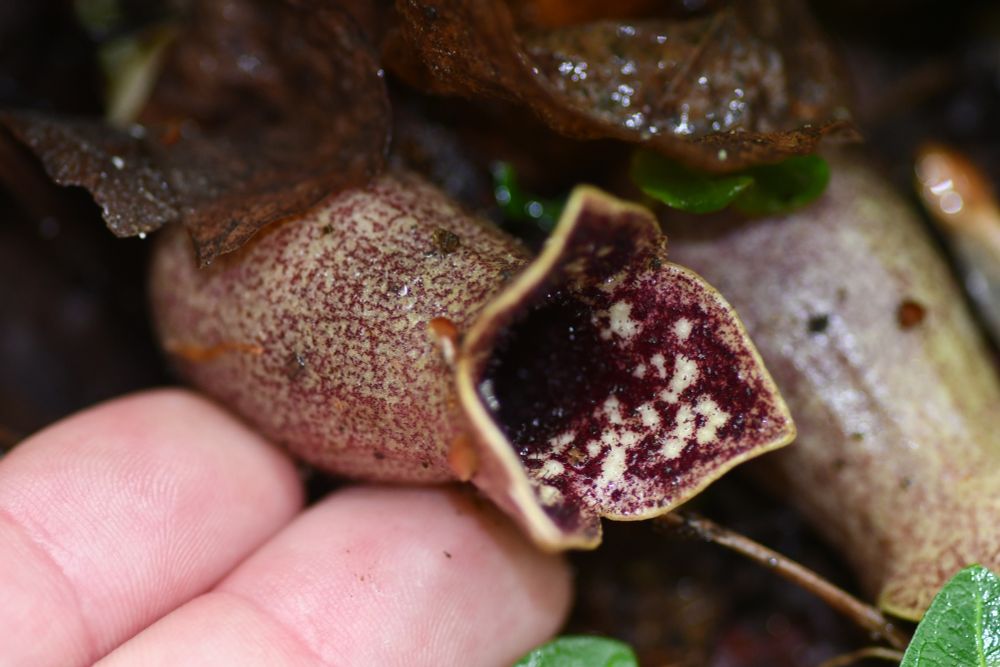
(10) Asarum sp. (possibly A. shuttleworthii, the largeflower heartleaf), in bloom. The heartleafs (family Aristolochiaceae) are sometimes considered to be their own segregate genus, Hexastylis. Flowers are purple/brown and smell like carrion, presumably an adaptation for fly pollination 🥰
04.05.2025 16:13
👍 3
🔁 0
💬 0
📌 0
*Correction: apparently Leptinotarsa do not actually have larval fecal shields. I was mistaking them for the similarly-named three-lined potato beetle (Lema daturaphila). But, the general phenomenon is still quite widespread in this beetle family.
29.04.2025 14:27
👍 0
🔁 0
💬 0
📌 0

(9) Krigia virginica (Virginia dwarf dandelion) capitulum with developing achenes (I think that's what these are?). Superficially this reminds me of the flower heads of Navarretia or Gilia.
29.04.2025 04:19
👍 4
🔁 0
💬 2
📌 0

(8) Nerodia sipedon (common watersnake) in a group on some river debris. This area got a lot of wind damage and flooding during Hurricane Helene back in September but not as bad as further east. Not sure what is happening in this photo -- maybe they form mating balls like some other snakes?
29.04.2025 04:19
👍 1
🔁 0
💬 1
📌 0

(7) Pyrularia pubera (buffalo nut), a hemiparasitic understory shrub in the Santalaceae (same family as the more familiar mistletoes). It apparently is a generalist in its host associations. In reading about it, I also learned that there are a few other shrubby genera in the family (e.g., Buckleya)
29.04.2025 04:19
👍 1
🔁 0
💬 1
📌 0


(6) Trillium vaseyi, endemic to western NC, SC, and northern GA (with a single disjunct population in AL). This species has among the largest flowers of any Trillium -- love the deep red / maroon color. The most common Trillium species in the area seems to be T. catesbaei.
29.04.2025 04:19
👍 2
🔁 0
💬 1
📌 0

(5) A nomad bee (Nomada sp.). Many species are kleoptoparasites of solitary ground-nesting bees like Andrena and are highly specialized, associating with only a single host. Nomada lack pollen-collecting hairs (scopae) on their hind-legs, as is true for other kleptoparasitic bees (e.g. Coelioxys).
29.04.2025 04:19
👍 0
🔁 0
💬 1
📌 0

(4) Leptinotarsa juncta (false potato beetle), seen here on Solanum carolinense (horsenettle). Like many chrysomelids, its larvae have fecal shields that probably serve as predator deterrents. Unlike its congener the Colorado potato beetle, this species is not considered an agricultural pest.
29.04.2025 04:19
👍 5
🔁 0
💬 2
📌 0

(3) Pseudothyris sepulchralis (mournful thyris moth), a really striking moth that is part of a family (Thyrididae) of primarily day-flying moths. The larval hosts are reported to be greenbriers (Smilax sp.); Pickens County, where I grew up, has about a dozen species of Smilax!
29.04.2025 04:19
👍 0
🔁 0
💬 1
📌 0

(2) First up: Magnolia fraseri (Fraser's magnolia), native to the southern Appalachians and a sliver of SC. Grows in moist soil and has some of the largest leaves of any temperate North American tree (regularly >18 inches in length).
29.04.2025 04:19
👍 3
🔁 0
💬 1
📌 0
(1) Got to spend a few days back home in South Carolina during peak springtime. Here are some photos and natural history tidbits!
29.04.2025 04:19
👍 6
🔁 0
💬 1
📌 0

Shocker: This tropical tree thrives after being struck by lightning
The almendro withstands thunderbolts that blast away parasitic vines
👀 Ok, if true this is a shocking way to blast through the forest canopy, remove lianas, & dominate "The idea that lightning strikes give almendros a competitive advantage-The almendro tree is so tolerant of strikes, in fact, that it may well be summoning lightning" www.science.org/content/arti... 🌐🧪
27.03.2025 03:44
👍 95
🔁 36
💬 3
📌 3

Seussian pink flowers in a sand dune

Monarch on flower

Skipper on flower

Gulf Fritillary on Flower
First lab paper out in a long time - this one looking at pollination/pollinators/floral volatiles of an AWESOME species of sand verbena from South Texas. All credit to my wonderful grad student Sierra and collaborators. (more photos below) www.pollinationecology.org/index.php/jp...
24.03.2025 19:13
👍 10
🔁 3
💬 1
📌 0
(2/2) I think Ezra Klein understands the importance of the climate crisis and living on a finite planet. Building affordable housing and infrastructure (and a political coalition along with it) is part of the solution.
23.03.2025 21:52
👍 0
🔁 0
💬 0
📌 0
(1/2) Haven’t read the book yet, but am familiar with its central thesis. If progressive politics don’t allow for building a four story apartment building in San Francisco (much less CA high speed rail), how to advance a credible vision that addresses bigger problems like decarbonizing the economy?
23.03.2025 21:48
👍 0
🔁 0
💬 1
📌 0
Our department (@EEBUofT) is searching for a Post-Doc! Post-docs funded by this fellowship are independently supported, with research funds available. We invite applications from innovative, collaborative candidates. See the job ad here:
eeb.utoronto.ca/wp-content/u...
18.03.2025 18:29
👍 69
🔁 66
💬 5
📌 3
Within 24 hr of posting this we’re back to -4C. Fuzzy friend may have jumped the gun
12.03.2025 20:15
👍 0
🔁 0
💬 0
📌 0
In reverent awe of @beemachine.bsky.social
12.03.2025 20:07
👍 2
🔁 0
💬 1
📌 0

On top, five Andropogoneae grass species, from left to right Zea mays subsp. mays, Hemarthria uncinata, Miscanthus sinensis, Sorghum bicolor, Andropogon gerardi. On bottom, a map of the world, with collection sites of Andropogoneae grasses in points. A green background shows the distribution of Andropogoneae grasses throughout tropical and temperate latitudes

On left, a phylogeny of Andropogoneae species, with 14 independent polyploidy origins noted. On right, genome size and repeat content of each assembly. Across all assemblies, average assembly size is 1.9 Gb, and average repeat size is 1.5 Gb.
New preprint featuring my favorite maize-relatives, the Andropogoneae! We sequenced the genomes of 27 species, including lemongrass, kangaroo grass, little and big bluestem, and more -- key species that shape grasslands and prairies worldwide. www.biorxiv.org/content/10.1...
27.01.2025 21:33
👍 51
🔁 30
💬 1
📌 0

First warm day of the year in Toronto today (11C). Saw my first bee even though there’s still snow on the ground in places and not even the crocuses aren’t up yet. Anyone know if this is Osmia?
12.03.2025 02:05
👍 5
🔁 1
💬 2
📌 0
I'm thrilled to be opening my own lab this Fall at the @maxplanck.de MPI for Brain Research in Frankfurt. The lab is going to investigate the neuronal and genetic underpinnings of behavioral evolution. We are hiring on all levels. Don't hesitate to share widely and reach out if interested.
08.01.2025 16:53
👍 141
🔁 50
💬 21
📌 2

Here's a photo from December 2024 in White Sands National Park 🙂
09.03.2025 16:32
👍 4
🔁 1
💬 0
📌 0
Anyway, I'll try to post periodically here and see how it goes.
09.03.2025 16:32
👍 0
🔁 0
💬 1
📌 0
Slow to make the jump from Twitter, but it had stopped being a useful platform for me. Whole point of being there was to see/participate in conversations about science. Seems like some combo of (1) people I followed stopped posting/engaging and (2) the algorithm only amplifies blue check effluvium
09.03.2025 16:32
👍 2
🔁 0
💬 1
📌 0