Australia's human rights record under scrutiny through 2025-26 UN Universal Periodic Review - Human Rights Law Centre
Important report on Australia’s #humanrights record from a coalition of Australian NGOs. In 2025-26 the Australian Government undergoes scrutiny under the #UnitedNations Human Rights Council in Geneva for the Universal Periodic Review www.hrlc.org.au/projects/uni...
20.01.2026 07:23
👍 0
🔁 0
💬 0
📌 0

A legacy of excluding women from clinical trials means Australia’s medical system is fundamentally skewed, with women more likely to be misdiagnosed, experience adverse drug reactions and receive less effective treatment for common conditions.
Read more: buff.ly/wviZKnh
15.01.2026 22:02
👍 3
🔁 2
💬 0
📌 0
🔔 NEW in the Medical Journal of Australia
How Can We Ensure Access to Sexual and Reproductive Health Information for Adolescents in Light of Australia's Social Media Restrictions?
✍️ Olena Ivanova, Anisa R. Assifi, Danielle Mazza
19.01.2026 01:00
👍 0
🔁 1
💬 0
📌 0

The MJA is pleased to announce a call for papers for a Special Collection on Indigenous Health, which will have a publishing run from NAIDOC week 2026 until the end of 2026. The call for papers runs from now until 31 March 2026.
For more information, click here: buff.ly/NIeVy94
05.01.2026 01:56
👍 5
🔁 5
💬 0
📌 0

A table showing profit margins of major publishers. A snippet of text related to this table is below.
1. The four-fold drain
1.1 Money
Currently, academic publishing is dominated by profit-oriented, multinational companies for
whom scientific knowledge is a commodity to be sold back to the academic community who
created it. The dominant four are Elsevier, Springer Nature, Wiley and Taylor & Francis,
which collectively generated over US$7.1 billion in revenue from journal publishing in 2024
alone, and over US$12 billion in profits between 2019 and 2024 (Table 1A). Their profit
margins have always been over 30% in the last five years, and for the largest publisher
(Elsevier) always over 37%.
Against many comparators, across many sectors, scientific publishing is one of the most
consistently profitable industries (Table S1). These financial arrangements make a substantial
difference to science budgets. In 2024, 46% of Elsevier revenues and 53% of Taylor &
Francis revenues were generated in North America, meaning that North American
researchers were charged over US$2.27 billion by just two for-profit publishers. The
Canadian research councils and the US National Science Foundation were allocated US$9.3
billion in that year.

A figure detailing the drain on researcher time.
1. The four-fold drain
1.2 Time
The number of papers published each year is growing faster than the scientific workforce,
with the number of papers per researcher almost doubling between 1996 and 2022 (Figure
1A). This reflects the fact that publishers’ commercial desire to publish (sell) more material
has aligned well with the competitive prestige culture in which publications help secure jobs,
grants, promotions, and awards. To the extent that this growth is driven by a pressure for
profit, rather than scholarly imperatives, it distorts the way researchers spend their time.
The publishing system depends on unpaid reviewer labour, estimated to be over 130 million
unpaid hours annually in 2020 alone (9). Researchers have complained about the demands of
peer-review for decades, but the scale of the problem is now worse, with editors reporting
widespread difficulties recruiting reviewers. The growth in publications involves not only the
authors’ time, but that of academic editors and reviewers who are dealing with so many
review demands.
Even more seriously, the imperative to produce ever more articles reshapes the nature of
scientific inquiry. Evidence across multiple fields shows that more papers result in
‘ossification’, not new ideas (10). It may seem paradoxical that more papers can slow
progress until one considers how it affects researchers’ time. While rewards remain tied to
volume, prestige, and impact of publications, researchers will be nudged away from riskier,
local, interdisciplinary, and long-term work. The result is a treadmill of constant activity with
limited progress whereas core scholarly practices – such as reading, reflecting and engaging
with others’ contributions – is de-prioritized. What looks like productivity often masks
intellectual exhaustion built on a demoralizing, narrowing scientific vision.

A table of profit margins across industries. The section of text related to this table is below:
1. The four-fold drain
1.1 Money
Currently, academic publishing is dominated by profit-oriented, multinational companies for
whom scientific knowledge is a commodity to be sold back to the academic community who
created it. The dominant four are Elsevier, Springer Nature, Wiley and Taylor & Francis,
which collectively generated over US$7.1 billion in revenue from journal publishing in 2024
alone, and over US$12 billion in profits between 2019 and 2024 (Table 1A). Their profit
margins have always been over 30% in the last five years, and for the largest publisher
(Elsevier) always over 37%.
Against many comparators, across many sectors, scientific publishing is one of the most
consistently profitable industries (Table S1). These financial arrangements make a substantial
difference to science budgets. In 2024, 46% of Elsevier revenues and 53% of Taylor &
Francis revenues were generated in North America, meaning that North American
researchers were charged over US$2.27 billion by just two for-profit publishers. The
Canadian research councils and the US National Science Foundation were allocated US$9.3
billion in that year.

The costs of inaction are plain: wasted public funds, lost researcher time, compromised
scientific integrity and eroded public trust. Today, the system rewards commercial publishers
first, and science second. Without bold action from the funders we risk continuing to pour
resources into a system that prioritizes profit over the advancement of scientific knowledge.
We wrote the Strain on scientific publishing to highlight the problems of time & trust. With a fantastic group of co-authors, we present The Drain of Scientific Publishing:
a 🧵 1/n
Drain: arxiv.org/abs/2511.04820
Strain: direct.mit.edu/qss/article/...
Oligopoly: direct.mit.edu/qss/article/...
11.11.2025 11:52
👍 642
🔁 453
💬 8
📌 66

Four speakers
Great discussion at launch today of 2030 Healthy Countdown Supplement, published in the MJA www.mja.com.au/journal/2025...
Sharon Goldfeld, Kate Lycett, Pasi Sahlberb, Planning Saw & Prue Warrilow
Very proud at @mja.com.au to publish from this important project www.aracy.org.au/future-healt...
10.11.2025 01:01
👍 4
🔁 0
💬 0
📌 0

EiC Ginny Barbour receiving the stick from Uncle Paul Scott
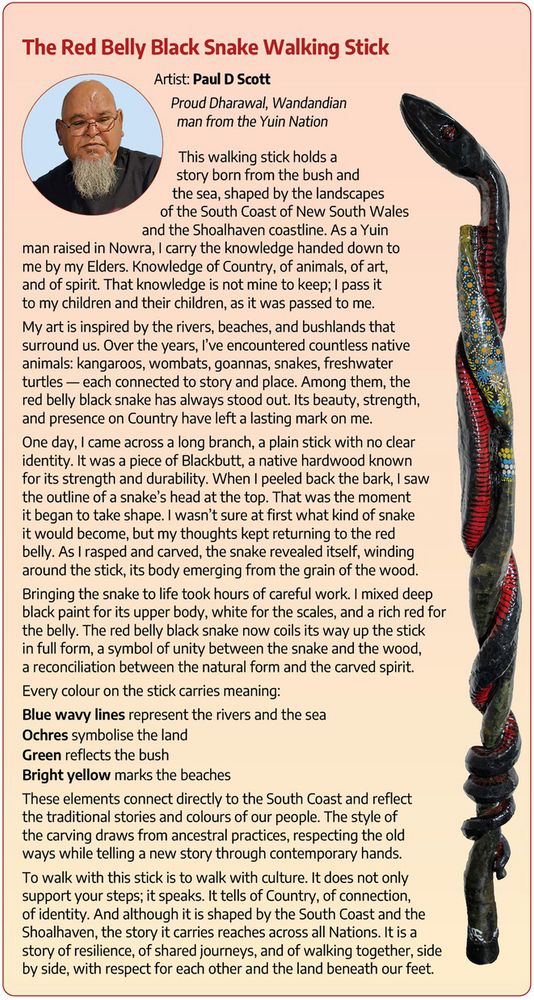
The story of the walking stick written by Uncle Paul Scott

The cover of the 2025 MJA Special issue on Indigenous Health
Last week, at a ceremony on the University of Wollongong campus on the beautiful lands of the Wandi Wandian and Dharawal Peoples @mja.com.au were honoured to receive a walking stick from Uncle Paul Scott who carved it for the 2025 Special Issue on Indigenous Health. www.mja.com.au/journal/2025...
30.09.2025 22:51
👍 7
🔁 1
💬 0
📌 0

Cover of Australia's first National Climate Risk Assessment
Key finding: "Extreme heat, floods, bushfires, poor air quality &
communicable diseases will escalate health risks.
Those with pre-existing health conditions, including mental ill-health, are most at risk. This includes the very young & our older populations... www.acs.gov.au/pages/nation...
15.09.2025 04:21
👍 4
🔁 0
💬 0
📌 0
MSN
The Australian CDC will provide central, credible information, with threats like bird flu, and #PublicHealth misinformation and falling immunisation rates, PHAA CEO Adj Prof Terry Slevin told AAP. The bills to establish the CDC were introduced to parliament on 3 Sept. Read story: shorturl.at/Agzk7
05.09.2025 01:27
👍 4
🔁 2
💬 0
📌 0

🔔 NEW in InSight+
The National Mental Health Commission’s 2024 Report Card shines a spotlight on the urgent need for a more coordinated and equitable mental health system in Australia.
Read more: buff.ly/74Qs4Ct
04.09.2025 22:01
👍 1
🔁 2
💬 0
📌 0

This week in InSight+
While health care practitioners are aware of “Doctor Google”, they may not be aware that their patients are turning to AI chatbots for mental health information, clinical advice, and real-time support.
buff.ly/NHofB2Y
25.08.2025 22:00
👍 1
🔁 1
💬 0
📌 0

Health care both contributes to and is affected by climate change. InSight+ spoke with researchers who recommend that Australia follow other nations and commit to considering environmental impact in healthcare technology assessments
buff.ly/a4PWVgL
26.08.2025 05:00
👍 1
🔁 2
💬 0
📌 0
Still time to register for this today!
26.08.2025 20:34
👍 1
🔁 1
💬 0
📌 0

The public health impacts of mining in Australia
A multisectoral approach and stronger multilevel government coordination are required to address the health impacts associated with proximity to mining and exposure to toxic chemicals
Important new paper published online first in @mja.com.au today on the public health impacts of mining in Australia. We are familiar with the #environmental and #climate effects of mining but the health impacts of mining in the general population are poorly studied.
www.mja.com.au/journal/2025...
25.08.2025 01:11
👍 5
🔁 0
💬 0
📌 0

🔔 NEW in the Medical Journal of Australia
Innovative approaches to fall prevention in community‐dwelling older adults
✍️ Kim Delbaere, Catherine Sherrington, Catherine M Said and Vasikaran Naganathan
buff.ly/xIY4PQG
18.08.2025 02:00
👍 0
🔁 1
💬 0
📌 0
Listen to the latest MAJ podcast, as we celebrate 10 years of clinical care standards with Chief Medical Officer of the Commission Conjoint Professor Carolyn Hullick and Clinical Care Standards Director Dr Alice Bhasale
🎧 buff.ly/pmavSGs
18.08.2025 05:00
👍 1
🔁 1
💬 0
📌 0

Some history from an Indigenous scholar on the weaponisation of starvation to acquire land
Some history from an Indigenous scholar on the weaponisation of starvation to acquire land www.croakey.org/some-history...
18.08.2025 06:55
👍 8
🔁 3
💬 0
📌 0

Cover of MJA issue on healthy ageing
Very proud that the current issue of @mja.com.au focuses on #healthy #ageing - one of today's most important societal health challenges. buff.ly/s3JLbtv
Articles on: fall prevention; indicators of quality & safety of long term aged care; models of care across settings supporting ageing in place
18.08.2025 06:30
👍 1
🔁 1
💬 0
📌 0

Image of cane burning

Map showing cases of Weil's disease
Some fascinating history here including reference to the 1934 account in @mja.com.au of Weil's disease in cane workers in Northern Queensland. onlinelibrary.wiley.com/doi/epdf/10....
www.abc.net.au/news/2025-08...
18.08.2025 01:03
👍 1
🔁 2
💬 0
📌 0

A new study has found significant variations in the quality of aged care across Australia, highlighting the need for targeted quality improvement programs
Read more: buff.ly/FQbGHu9
15.08.2025 00:02
👍 1
🔁 2
💬 0
📌 0

Care about #reproducibility in research & publishing? Join this webinar on Aug 27th, jointly organised by @aimosinc.bsky.social & @ausrepro.bsky.social on statistical reproducibility with @michelenuijten.bsky.social & @tomhardwicke.bsky.social Free - register here qut.zoom.us/meeting/regi...
06.08.2025 08:43
👍 16
🔁 16
💬 0
📌 2

🔔 This week in InSight+
Five stories of excellence from across Australia reveal how health services are using the Clinical Care Standards to drive meaningful improvements in safety, consistency and outcomes for patients.
buff.ly/F1ekFXI
28.07.2025 22:00
👍 0
🔁 1
💬 0
📌 0

🔔 NEW in the Medical Journal of Australia
Dialysis care in Australia: a call for reform and innovation
✍️ Dharshana Sabanayagam, Angela Makris, Frederika Sciberras, Nicole J Scholes‐Robertson and Germaine Wong
buff.ly/OUoBdVO
29.07.2025 00:00
👍 0
🔁 1
💬 0
📌 0

Photo by Glen Carrie on Unsplash
Heard the news about the UK lowering the voting age to 16?
www.theguardian.com/politics/202...
Here's the rationale for this in Australia - published last year as part of VicHealth Future Healthy Countdown 2030 supplement in @mja.com.au
www.mja.com.au/journal/2024...
www.mja.com.au/journal/2024...
17.07.2025 22:46
👍 1
🔁 1
💬 0
📌 0
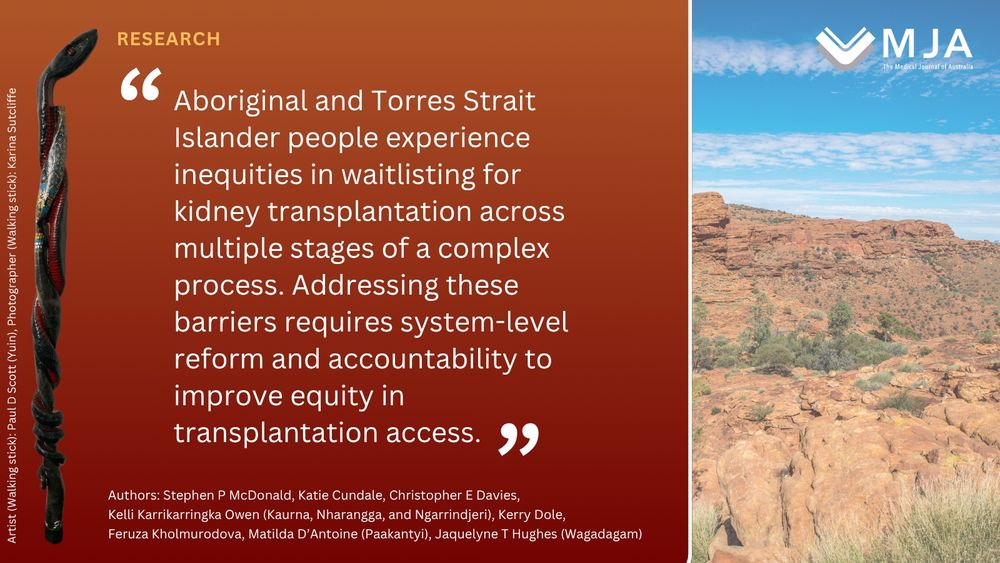
Quote from this paper "Am I on the list? Clinician‐reported factors for kidney transplantation non‐waitlisting among Aboriginal and Torres Strait Islander people with kidney failure: a cross‐sectional study" https://www.mja.com.au/journal/2025/223/1/am-i-list-clinician-reported-factors-kidney-transplantation-non-waitlisting
The final paper is from Stephen McDonald and colleagues "Am I on the list? Clinician‐reported factors for kidney transplantation non‐waitlisting among Aboriginal and Torres Strait Islander people with kidney failure: a cross‐sectional study" www.mja.com.au/journal/2025...
11.07.2025 05:49
👍 0
🔁 0
💬 0
📌 0