
Photo of Dr Joseph McNeil.
Our second Keynote speaker for BPSC 2026 is Dr Joseph McNeil (Natural History Museum, London).
Dr McNeil is a planetary scientist specialising in the geology of early Mars. He uses orbital remote sensing to investigate how martian environments and habitability evolved through time.
02.02.2026 16:46
👍 7
🔁 2
💬 0
📌 0

An outside view of the Waterhouse building of Natural History Museum, London, with blue sky and a few clouds. A bronze cast of a diplodocus dinosaur is in the foreground.

A colourful image of impact crater densities on part of the Moon. Red and green rays emanate from the bottom left, the result of millions of secondary impact craters.
We have an STFC-funded PhD project at the @nhm-london.bsky.social. Work with me, @joemcneil.bsky.social, @katie-h-joy.bsky.social, and Gareth Collins, and share in the fun of secondary impact craters and landing sites!
tinyurl.com/nez8dzsy
15.01.2026 09:30
👍 9
🔁 6
💬 0
📌 0
The mounds are geochemically similar to the plains of Oxia Planum, the future landing site of the ExoMars Rosalind Franklin rover. Thus, when ExoMars is exploring these plains, it will also be exploring widespread regional environments beyond the landing site alone.
20.01.2025 16:40
👍 2
🔁 0
💬 1
📌 0
These erosional remnants contain hundreds of meters of clay-rich stratigraphy, indicating liquid water was present here for a substantial amount of time. The clays are bounded above and below by unaltered material, documenting (almost) the entire aqueous history of the region.
20.01.2025 16:40
👍 1
🔁 0
💬 1
📌 0
The headlines: Mars' highlands once extended hundreds of kilometres further north in the Chryse Planitia region. In the Noachian, between 3.8 and 4.0 billion years ago, erosion removed the edge of the highlands, leaving remnant mounds.
20.01.2025 16:40
👍 1
🔁 0
💬 1
📌 0
I am happy to announce the publication of the final part of my @openuniversity.bsky.social PhD work, which has been expanded during my UKSA postdoc @nhm-london.bsky.social: "Dichotomy retreat and aqueous alteration on Noachian Mars recorded in highland remnants”, in @naturegeosci.bsky.social.
20.01.2025 16:40
👍 10
🔁 1
💬 1
📌 0
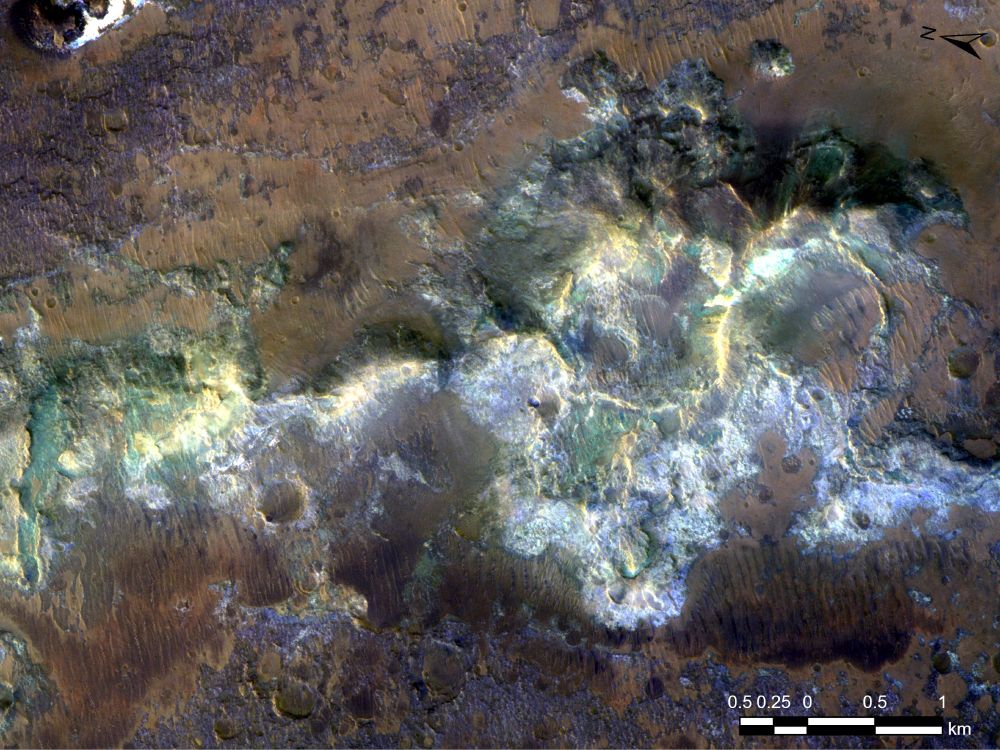
Some parts of Mars are deliciously colourful.
Here's part of the western Ladon basin, as seen in false colour by the CaSSIS instrumnet on the TGO spacecraft.
Image no. MY35_012192_201_0, taken in January 2021.
(Credit: ESA/TGO/CASSIS/Peter Grindrod)
08.01.2025 16:32
👍 37
🔁 10
💬 2
📌 0
Super excited to start fresh here (and by “start fresh”, I mean “lurk in the background and occasionally post when I remember”, as is tradition).
27.11.2024 08:50
👍 2
🔁 0
💬 0
📌 0
My research covers many aspects of martian stratigraphy, geomorphology, and mineralogy, and I’m always up for chatting about planetary science in general.
27.11.2024 08:50
👍 1
🔁 0
💬 1
📌 0
I use remote sensing data to study the role of water on ancient Mars. Basically, if it was once wet, is now rock, and happens to be on Mars, I’m interested in investigating it from orbit. But I’m more than happy to look at any and all planetary surfaces!
27.11.2024 08:50
👍 1
🔁 0
💬 1
📌 0
Hey everyone! Some introductory stuff: I’m Joe, a postdoc at the Natural History Museum in London. Like many of you, I’ve decided it’s time to jump on the great Bluesky bandwagon.
27.11.2024 08:50
👍 11
🔁 1
💬 1
📌 0
Is this thing on?
20.11.2024 10:58
👍 6
🔁 0
💬 2
📌 0


